EVIDENCE-BASED DREAMWORK
Publications
Explore practical, research-informed approaches to dreams and nightmares. Learn how dreamwork can support trauma recovery and emotional well-being—for clinicians and curious minds alike.
Explore practical, research-informed approaches to dreams and nightmares. Learn how dreamwork can support trauma recovery and emotional well-being—for clinicians and curious minds alike.
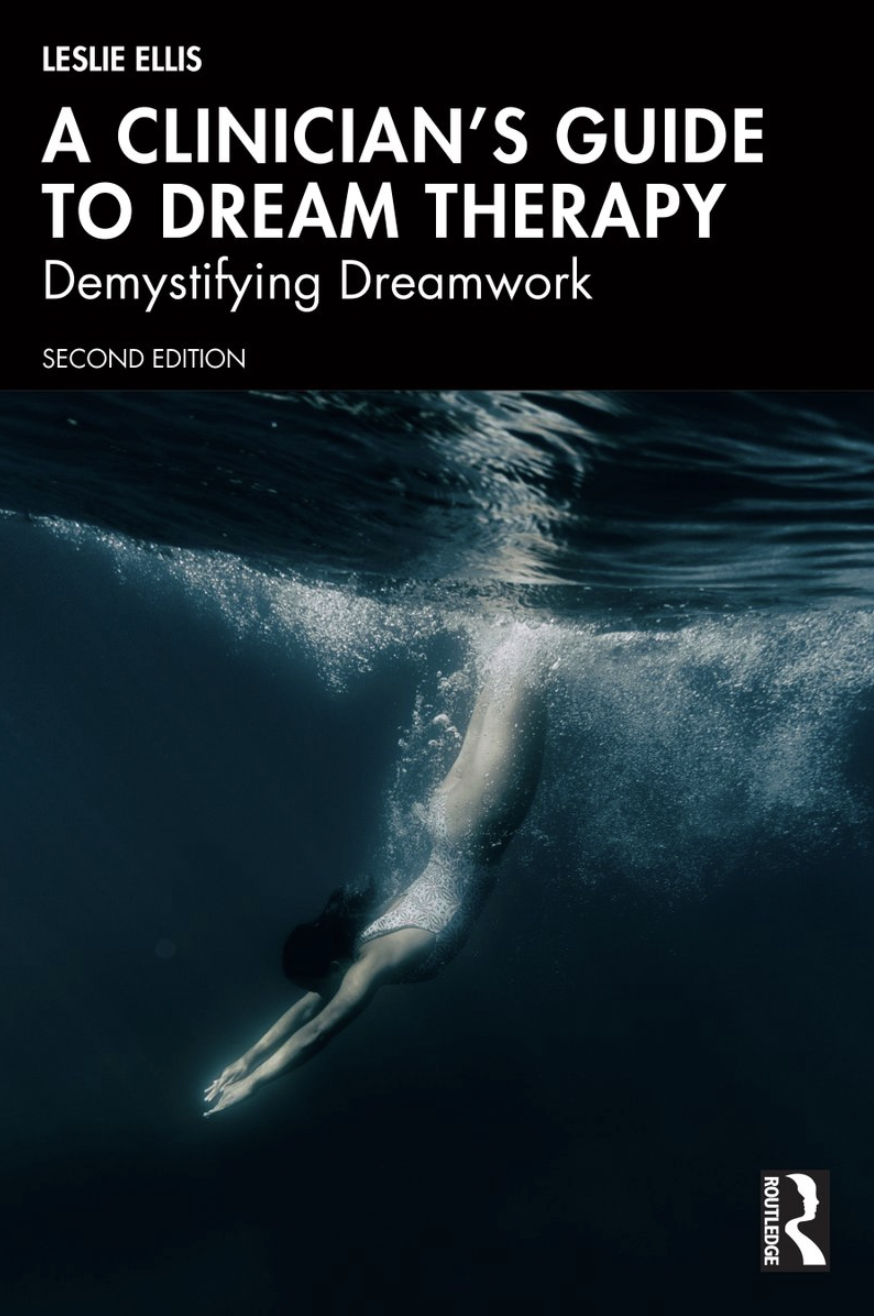
A Clinician’s Guide to Dream Therapy (Second Edition) is a research-informed, practical guide to working with dreams and nightmares in psychotherapy. Drawing on over 25 years of clinical experience, Dr. Leslie Ellis offers a clear and compassionate framework for integrating dreamwork into trauma-informed practice, with new chapters on nightmares, updated case examples, and step-by-step tools for experiential work.
"Leslie Ellis is in my view the world’s best clinician and writer in the area of dream and nightmare treatment. She is scholarly and has an in-depth knowledge of brain-body interaction, but writes very accessibly, with great examples of how dreams -- even the most horrific -- can take a client to a better waking life."Shop Book
Steve Biddulph, best-selling author of Wild Creature Mind, Fully Human and 6 other titles
This list includes peer-reviewed journal articles, a doctoral dissertation, and selected book chapters.
Ellis, L. A. (2024). The alarming nightmare–suicide link: Evidence, theories, and implications for treatment. Journal of Projective Psychology and Mental Health.
Ellis, L. A. (2023). Diving deep: Three experiential approaches to working with dreams and nightmares. Person-Centered & Experiential Psychotherapies. https://doi.org/10.1080/14779757.2023.2169841
Ellis, L. A. (2023). Solving the nightmare mystery: The autonomic nervous system as a missing link in the aetiology and treatment of nightmares. Dreaming. https://doi.org/10.1037/drm0000224
Ellis, L. A. (2019). Common factors leading to a universal approach to dreamwork: A qualitative analysis. Dreaming, 29(1), 22–39. https://doi.org/10.1037/drm0000099
Ellis, L. A. (2019). Body dreamwork: Using focusing to find the life force inherent in dreams. International Body Psychotherapy Journal: The Art and Science of Somatic Praxis, 18(2), 75–85.
Ellis, L. A. (2016). Qualitative changes in recurrent PTSD nightmares after focusing-oriented dreamwork. Dreaming, 26(3), 185–201. https://doi.org/10.1037/drm0000040
Ellis, L. A. (2014). The inner journey: Focusing and Jung. The Folio: A Journal for Focusing and Experiential Therapy, 25(1).
Ellis, L. A. (2013). Incongruence as a doorway to deeper self-awareness using experiential focusing-oriented dreamwork. Person-Centered & Experiential Psychotherapies, 12(3), 274–287. https://doi.org/10.1080/14779757.2013.835255
Ellis, L. A. (2012). The attuned brain: Crossings in focusing-oriented therapy and neuroscience. The Folio: A Journal for Focusing and Experiential Therapy, 23(1).
Ellis, L. A. (2011). A new understanding of grieving. Insights into Clinical Counselling. BC Association of Clinical Counsellors.
Ellis, L. A. (2015). Stopping the nightmare: An analysis of focusing-oriented dream imagery therapy for trauma survivors with repetitive nightmares (Doctoral dissertation). The Chicago School of Professional Psychology.
Ellis, L. A. (2021). Gendlin’s unique contribution to dreamwork: Embodying helpful and contrary elements to bring in the new. In J. Moore & N. Kypriotakis (Eds.), Senses of focusing. Athens, Greece: Eurasia Publications.
Ellis, L. A. (2019). Body dreamwork: Using focusing to interpret your dreams. In Dreams: Understanding biology, psychology, and culture (2-volume reference work). ABC-CLIO / Greenwood.
Ellis, L. A. (2016). Focusing-oriented dreamwork. In J. Lewis & S. Krippner (Eds.), Working with dreams and nightmares: 14 approaches for psychotherapists and counselors. Praeger.
Ellis, L. A. (2014). Living the dream: Evolving approaches to focusing-oriented and embodied dreamwork. In G. Madison (Ed.), Advances in focusing-oriented psychotherapy. London: Jessica Kingsley Publishers.
